
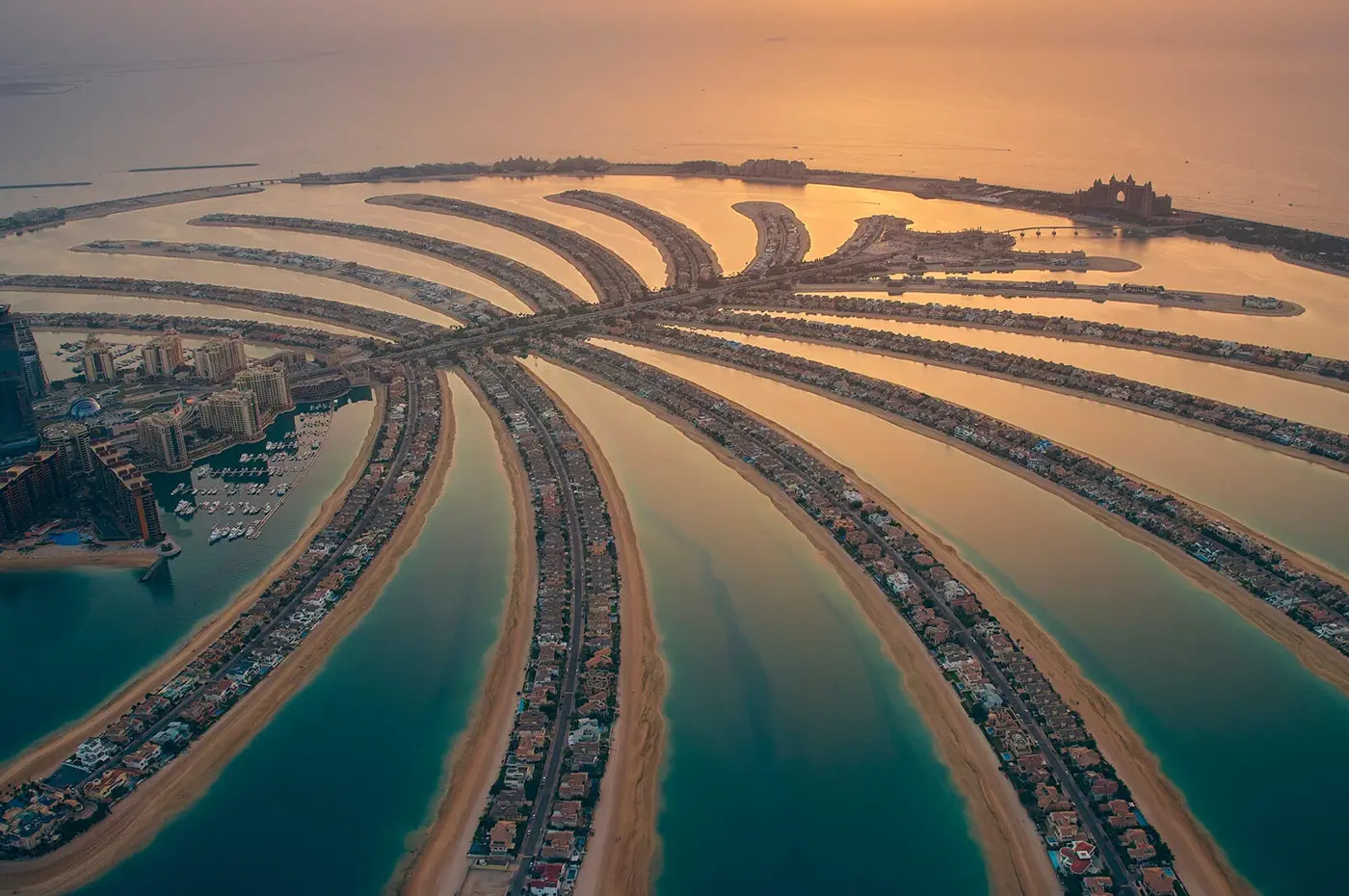
Palm Jumeirah at 25 — how the crescent is evolving in 2026
When Nakheel announced Palm Jumeirah in 2001, the vision was audacious: a palm-shaped archipelago visible from space, lined with private villas and anchored by
Palm Jumeirah at 25 — how the crescent is evolving in 2026
A quarter-century after dredging began, the world's largest man-made island is no longer just about villas and beach clubs—it is quietly being recast as Dubai's most concentrated showcase of branded living.
Introduction
When Nakheel announced Palm Jumeirah in 2001, the vision was audacious: a palm-shaped archipelago visible from space, lined with private villas and anchored by a luxury hotel at its crown. Twenty-five years later, the Crescent has matured into a self-contained neighbourhood of approximately 5,000 residences, four marinas, the Palm Monorail, and an evolving roster of ultra-prime projects. What began as a villa-led island is now witnessing a subtle but decisive pivot. Branded residences—Six Senses The Palm, One&Only One Za'abeel's sister projects, Cavalli Estates, and others—are claiming frond tips and Crescent plots once earmarked for single-family homes. The shift mirrors broader trends across Emirates Hills, Jumeirah Bay Island, and the Downtown district, but Palm Jumeirah's geography and global recognition give it a gravitational pull few addresses can rival. For buyers and investors in 2026, the question is not whether the Palm remains prestigious—it does—but where value, yield, and liquidity intersect on an island where scarcity is both asset and constraint.
From garden villas to vertical signatures
For most of its first two decades, Palm Jumeirah's appeal rested on freehold garden villas along the sixteen fronds and select Crescent apartments. Atlantis The Palm dominated the skyline; everything else was low-rise and suburban in character. That equilibrium is shifting. Developers have pivoted toward branded, high-density towers on strategic Crescent and frond plots, reflecting tighter supply and stronger unit economics. Six Senses The Palm, delivered on the West Crescent, introduced hotel-managed penthouses and residences with direct beach access, spa facilities, and flexible rental pools—an archetype that marries second-home convenience with income potential. One&Only's residential arm and Cavalli Estates are pursuing similar formulas on adjacent plots, layering concierge services, interior design programmes, and exit guarantees that appeal to international portfolios. This wave matters because it redefines the Palm's product mix. Where buyers once chose between a AED 25–50 million frond villa or a mid-market apartment in Shoreline or Golden Mile, they can now access turnkey, yield-generating units in the AED 8–20 million band, backed by hospitality brands with proven track records in Phuket, Montenegro, and the Maldives. The villa market remains robust—families and long-term residents still prize private pools and waterfront berths—but for investors and part-year owners, the branded segment offers liquidity, management infrastructure, and marketing reach that standalone villas rarely match.
Price bands and transaction rhythms in 2026
Pricing on Palm Jumeirah in early 2026 spans one of the widest ranges in Dubai, reflecting the gulf between older apartment stock and ultra-prime new-builds. Off-plan branded residences on the Crescent are launching in the AED 8,000–12,000 per square foot range, positioning them alongside penthouses in the Burj Khalifa district and beachfront plots in Jumeirah Bay. Ready secondary apartments in Shoreline, Oceana, Azure, and Tiara typically trade between AED 2,000–3,500 per square foot, while Golden Mile resale units—often larger, with established community facilities—sit in the AED 3,200–5,500 per square foot band. Garden villas on fronds, meanwhile, move on land-value logic rather than cost-per-square-foot metrics; asking prices range from AED 25 million for interior frond plots to north of AED 80 million for signature tip villas with unobstructed gulf views and private jetties. Rental yields reflect this segmentation. Well-maintained two- and three-bedroom apartments in Shoreline or Azure can generate gross annual yields between 5.2 and 6.4 per cent—attractive by Dubai prime standards—while branded residences, burdened by higher purchase prices and management fees, typically settle closer to 4.5–5.8 per cent when owner-occupied part of the year. Villas rarely exceed 4 per cent gross yield but command long tenancies from senior executives and family offices seeking stability and school proximity. Transaction velocity remains healthy, supported by Palm Jumeirah's RERA title clarity, established owners' associations, and Nakheel's infrastructure stewardship.
Water taxis, monorail upgrades, and mobility logic
Mobility has always been Palm Jumeirah's paradox. The single trunk road delivers residents and visitors efficiently but concentrates traffic during peak hours, particularly at the Gateway junction. The Palm Monorail, operational since 2009, connects the Gateway station to Atlantis The Palm via Nakheel Mall, but its limited frequency and single route have constrained adoption among residents. In late 2025, Nakheel announced a phased upgrade: increased train frequency to every six minutes during morning and evening windows, extended operating hours until midnight on weekends, and integration with the wider Dubai Metro network via a planned Gateway interchange. Water taxis—historically a novelty—are being repositioned as serious transport alternatives. The Road and Transport Authority (RTA) and private marina operators now run scheduled and on-demand abra and yacht-taxi services linking Palm Jumeirah's four marinas with Dubai Marina, Bluewaters, and Jumeirah Beach Residence. While still niche, these services appeal to residents and guests who treat commute time as leisure, particularly during cooler months. For buyers, enhanced connectivity translates into broader tenant pools. Professionals working in Dubai Media City, Internet City, or Knowledge Village—all within five to eight kilometres—are increasingly willing to consider Palm Jumeirah apartments if monorail and water-taxi schedules reduce friction. The island's self-contained amenities—supermarkets, clinics, nurseries, beach clubs, fitness studios—mean households can go days without leaving the fronds, but reliable external links expand addressable demand beyond the ultra-wealthy and tourist segments.
Where value and upside converge today
For buyers approaching Palm Jumeirah in 2026, value depends on time horizon and use case. Secondary-market apartments in established clusters—Shoreline Apartments, Azure Residences, Oceana—offer proven cash flow, manageable service charges (typically AED 18–28 per square foot annually), and immediate availability. These buildings, now fifteen to twenty years old, have weathered maintenance cycles; diligent buyers who review sinking-fund audits and recent façade works can acquire solid, income-generating assets without the premium attached to new glass towers. Golden Mile Galleria, straddling the trunk between fronds and Crescent, blends apartment convenience with villa-style layouts—many units feature private gardens or rooftop terraces—and its managed community includes pools, gyms, and retail at grade. Prices sit above Shoreline but below Crescent new-builds, and the segment attracts families and investors in equal measure. At the ultra-prime end, off-plan branded projects still offer payment plans—typically 60/40 or 70/30 structures—that appeal to investors deploying capital over eighteen to thirty months. Cavalli Estates and similar launches allow buyers to lock in pre-completion pricing while deferring liquidity calls, though buyers must model developer track record, handover timelines, and the risk that oversupply in the branded segment could compress post-handover values if absorption slows. Villas remain the perennial safe haven. Despite steep entry prices, frond villas deliver scarcity, privacy, and a tangible land component that appreciates independently of building condition. Buyers with AED 35–60 million budgets and long hold periods—typically family offices or serial Dubai residents—anchor the villa segment and provide liquidity when motivated sellers emerge.
Practical takeaways
1.Distinguish use case from yield ambition early.If you seek 5.5–6.5 per cent gross rental returns and capital preservation, prioritise secondary Golden Mile or Shoreline apartments with transparent owners' association governance and recent refurbishment.
2.Evaluate branded residences as operating businesses, not trophy assets.Scrutinise the operator's rental pool terms, guaranteed-yield windows, furniture and fixture handover schedules, and any owner black-out periods that constrain personal use.
3.Negotiate villa purchases on land value and location, not interior finishes.Most frond villas are owner-customised; the premium lies in plot size, frond position (tip versus mid-frond versus trunk-adjacent), private berth access, and unobstructed sight lines.
4.Budget for service charges and community fees transparently.Apartment service charges on the Palm range from AED 18 to AED 35 per square foot annually; villa plots incur Nakheel community fees and often shared marina or beach-club dues. Include these in net-yield calculations.
5.Monitor Nakheel's infrastructure pipeline and RERA dispute logs.Palm Jumeirah's single master developer means large-scale decisions—beach nourishment, monorail upgrades, district cooling expansions—flow through one entity. Track official announcements and community feedback to anticipate capital calls or amenity improvements.
Frequently asked questions
- How do branded residences on Palm Jumeirah differ from hotel-apartment hybrid schemes elsewhere in Dubai?
Branded residences on the Palm—Six Senses, One&Only, Cavalli—are typically freehold, strata-titled units where the owner holds a distinct property certificate. The brand manages rental pools, housekeeping, and concierge services under a facilities-management agreement, but the owner retains full control over sale, mortgage, or inheritance. Hotel apartments, common in areas like Business Bay, often involve off-plan sale-and-leaseback structures or usufruct tenure that can complicate exit liquidity and financing.
- Are there still restrictions on short-term holiday rentals for private apartment owners on Palm Jumeirah?
Yes. RERA and the Dubai Tourism & Commerce Marketing authority classify properties into residential (long-term tenancy) and tourism (short-term let) categories. Only buildings explicitly licensed for holiday homes—or those enrolled in DTCM-approved rental-management programmes—may offer stays under 30 days. Many Palm Jumeirah apartment towers are designated residential-only, and owners who advertise on platforms without proper licensing risk fines. Always confirm your building's DTCM permit status before assuming short-let income.
What does the 2026 monorail upgrade mean for property values on the trunk versus the Crescent?
Improved frequency and late-night operation should moderately compress the convenience gap between trunk apartments (closer to Gateway) and Crescent residences, potentially supporting Crescent pricing. However, proximity to Atlantis amenities, beach clubs, and marina berths remains a stronger value driver than monorail access alone. Buyers should view the upgrade as a quality-of-life enhancement rather than a transformative pricing catalyst; broader metro integration, if realized, would carry greater weight.
- Speak to Point Penta
Palm Jumeirah at twenty-five is neither the villa-only sanctuary it once was nor the high-rise corridor some feared it might become. It is, instead, a layered market where legacy apartments, ultra-prime penthouses, and freehold garden villas coexist within a single, globally recognised postcode. Understanding which layer aligns with your capital allocation, tenancy strategy, and time horizon requires granular due diligence—reviewing strata titles, service-charge histories, operator agreements, and neighbourhood dynamics that few listing portals capture. Point Penta's research and transaction team works with buyers, landlords, and family offices navigating exactly these nuances across the Palm, Emirates Hills, Downtown, and beyond. If you are evaluating branded residences, secondary-market apartments, or villa opportunities on the Crescent or fronds, we invite you to visit our office at 902, Ithra Tower, Al Garhoud, Dubai, or reach out by email at info@pointpenta.com or by telephone at +971 55 739 6664. We look forward to guiding your next move with calm, evidence-led insight.
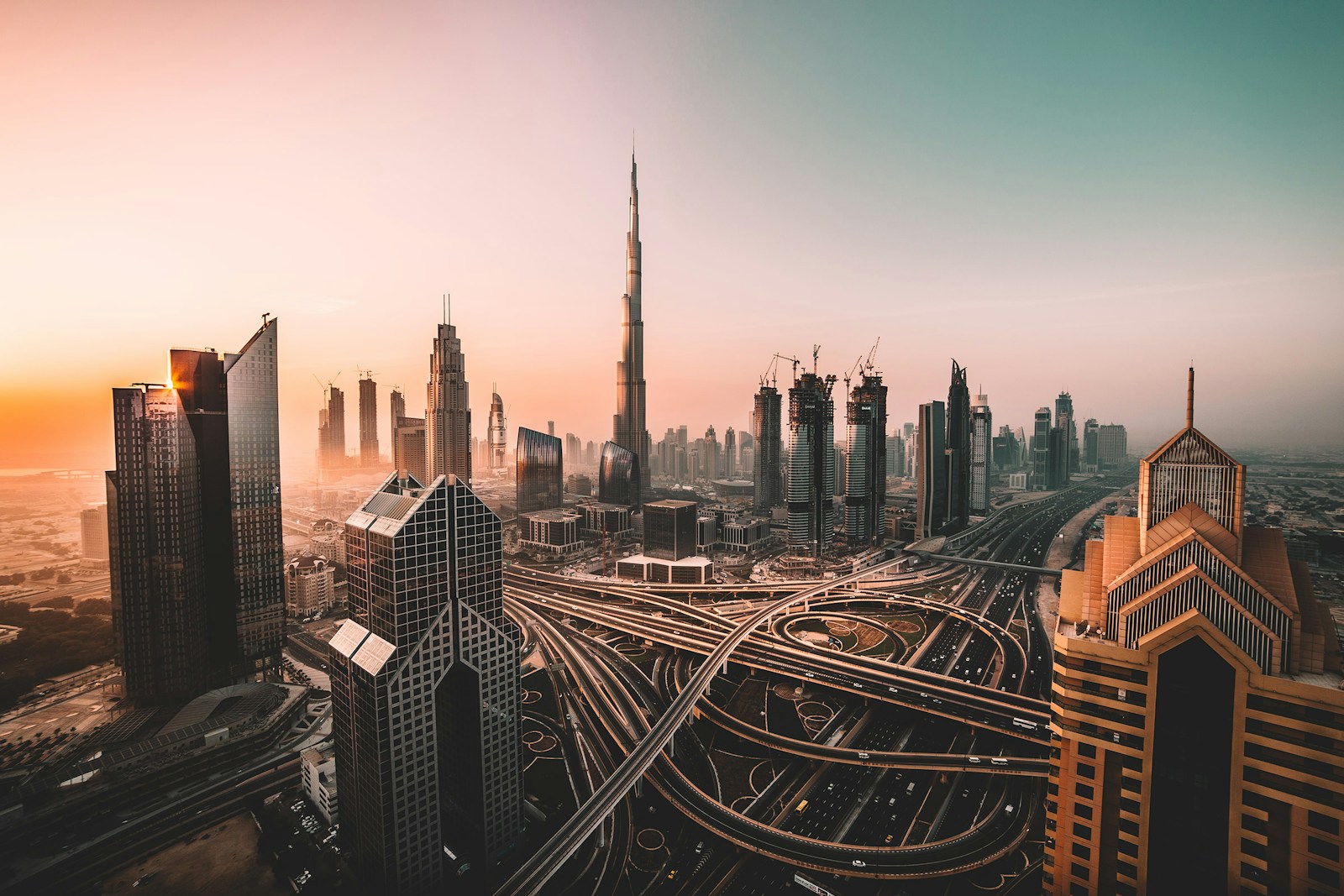
Point Penta’s research desk publishes editorial market analysis every week. If you’re looking at property in Dubai, an advisor will share the full sales pack — inventory, comparables and the current pricing band — within one business day.
More from the desk
How to sell your Dubai apartment in a rising market
Dubai's residential market has demonstrated sustained momentum since mid-2020, with quarterly DLD transaction volumes regularly exceeding historical averages an
Dubai property viewing checklist — 15 things every buyer misses
Dubai's property market moves quickly—handover schedules compress, inventory turns over, and buyers often feel pressed to commit after a single viewing. Yet the
Best time of year to buy in Dubai — a seasonal market analysis
Buying real estate in Dubai is rarely a straightforward exercise in supply and demand. The market breathes with the city's cultural calendar, developer event cy