Dubai Creek Harbour — Emaar's next Downtown
When Emaar Properties unveiled Dubai Creek Harbour in 2016, the ambition was explicit: to create a 6-square-kilometre freehold district that would echo the succ
Dubai Creek Harbour — Emaar's next Downtown
Six kilometres of waterfront, a Dubai landmark tower under construction, and an emerging skyline that will mirror Downtown's geometry from the opposite bank of the Creek.
Introduction
When Emaar Properties unveiled Dubai Creek Harbour in 2016, the ambition was explicit: to create a 6-square-kilometre freehold district that would echo the success of Downtown Dubai whilst introducing something the original masterplan never had—uninterrupted Creek frontage and unobstructed views back toward the Burj Khalifa skyline. Anchored by the Creek Tower—an observation spire designed by Santiago Calatrava—the development combines mid- and high-rise residential towers, retail promenades, yacht moorings, and landscaped parks across three main islands: Creek Island, Dubai Square, and the Sanctuary. As handovers accelerate between 2024 and 2027, the district is transitioning from blueprint to lived neighbourhood, offering a compelling counterpoint to communities such as Dubai Marina and Business Bay for families and investors seeking proximity to both old and new Dubai.
The masterplan: scale, connectivity, and parkland
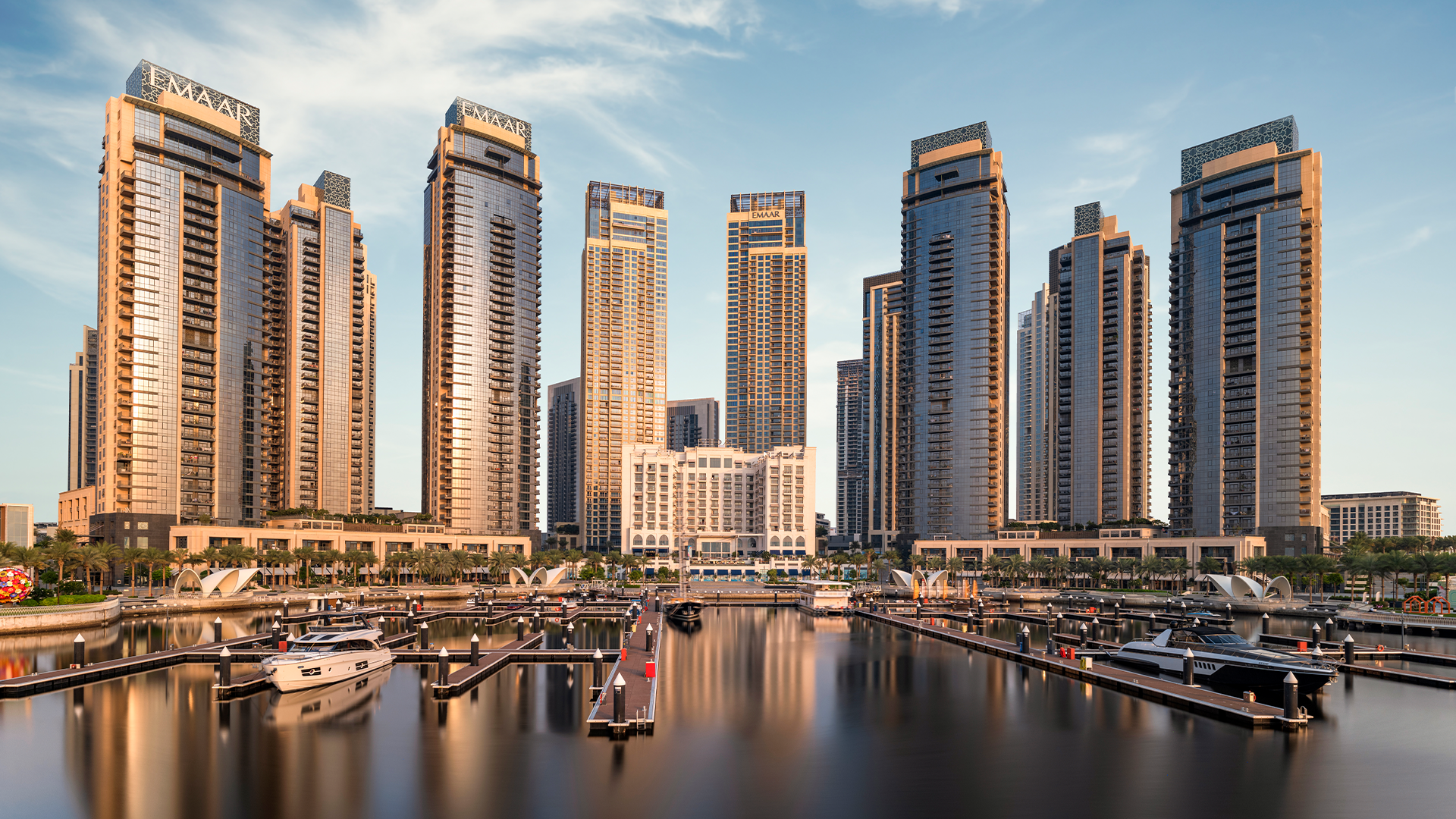
Dubai Creek Harbour spans approximately 6 square kilometres and is designed to house 200,000 residents upon completion. Three interlocking precincts define the layout. Creek Island—the first to break ground—hosts the majority of delivered residential towers, a yacht club, and the lagoon-front Creek Marina. Dubai Square, adjacent to the northern edge, is envisaged as the Middle East's largest retail and leisure destination, spanning 2.6 million square metres of built-up area. The Sanctuary, a protected mangrove reserve along the eastern shoreline, ensures green buffers and ecological continuity.
Vehicular access is anchored by the Creek Harbour Bridge, which connects directly to Al Jaddaf and Ras Al Khor Road, placing Downtown Dubai approximately twelve minutes away by car. The RTA has designated a future Dubai Metro extension route that will loop through the district, though construction timelines remain under review. Within the masterplan, 40 per cent of land is reserved for parks, boardwalks, and open spaces—a figure higher than most Dubai freehold districts—and cycling paths run unbroken along the Creek promenade. Emaar's stated design philosophy borrows from mixed-use pedestrian precedents: wide pavements, ground-floor retail activation, and mid-block passages that encourage walking over driving.
Delivered and near-complete towers: Address, Palace, Grove
Three flagship residential towers have begun handovers or are nearing practical completion, establishing the aesthetic and demographic baseline for the wider district. Address Harbour Point delivered in 2022 and comprises two forty-five-storey towers offering studio to three-bedroom apartments and a limited number of penthouses. Interiors feature oak flooring, Miele appliances, and floor-to-ceiling glazing; residents share access to three swimming pools, a paddle-tennis court, and the Address Hotels + Resorts concierge platform. Units here typically trade in the resale market within a range of AED 1,400–1,700 per square foot, though larger layouts with direct Creek views command premiums.
Creek Palace and The Cove at Creek Beach—both part of Emaar's mid-tier branding—are scheduled for handover in late 2024 and early 2025 respectively. Creek Palace offers one- to three-bedroom layouts across two towers, each under thirty storeys, with interiors by Nikki Beach and shared amenities including co-working lounges and children's play zones. The Cove introduces beach-club-style facilities—a rarity in inland Creek developments—alongside a lagoon swimming pool and outdoor cinema.
Harbour Views and Harbour Gate, sister projects within the Creek Marina precinct, add another 1,200 units to the delivered stock. Both are characterised by contemporary façades in white render and bronze aluminium, podium retail at grade, and views split between the Creek, the Dubai skyline, and internal garden courtyards. Collectively, these early towers confirm the district's positioning: aspirational without the premium of Downtown, family-friendly, and tilted toward owner-occupiers rather than short-term investors.
The skyline vista: framing the Burj from the east
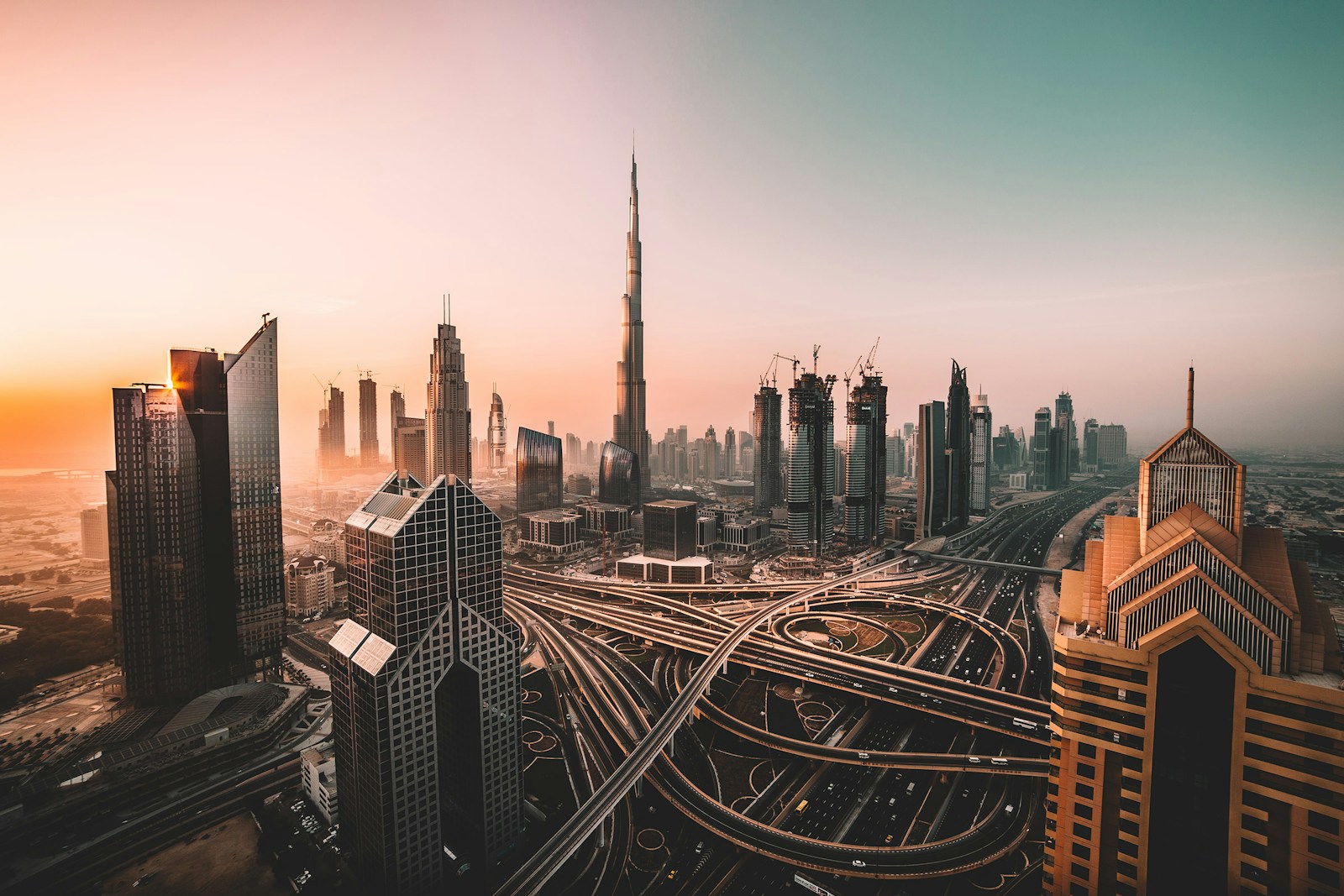
Dubai Creek Harbour's most distinctive spatial asset is its westward panorama. Standing on the Creek Island promenade at dusk, residents enjoy an unobstructed, head-on perspective of the Burj Khalifa, the Downtown cluster, and the Emirates Towers, framed by water in the foreground and desert haze beyond. This reverse geometry—observing Downtown from the Creek rather than the other way around—has become the district's signature marketing motif and a genuine point of differentiation.
The view corridor is protected by the masterplan's building envelope controls: no structure along the western edge of Creek Island exceeds forty-five storeys, ensuring sight lines remain open from mid- and high-rise units alike. For buyers, this translates into long-term view security—a consideration often underestimated in rapidly densifying districts such as Jumeirah Village Circle or Dubai South, where unplanned infill can obscure sight lines within a construction cycle.
Creek Marina amplifies the visual drama by positioning yacht berths and promenade seating directly along the water's edge, allowing evening strolls with the illuminated Burj as backdrop. The promenade is punctuated by palm groves, shaded pergolas, and outdoor cafés, mimicking the success of The Beach at JBR and La Mer whilst offering something neither can: an urban skyline view rather than open Gulf horizon. For photographers, influencers, and families with young children, this curated urban theatre has quickly become one of Dubai's most instagrammable—and lived—public spaces.
2025–2027 handover pipeline: what's coming next
Emaar's development schedule for Dubai Creek Harbour shows substantial momentum between now and the end of 2027.Creek Rise and Creek Horizon, both launched in 2021, are slated for handover in Q4 2025 and Q1 2026 respectively. Each comprises twin towers of thirty-eight and forty-two storeys, adding approximately 900 units of one-, two-, and three-bedroom stock. Both projects offer residents access to shared sky gardens, co-working lounges, and podium-level retail, continuing the district's amenity-rich typology.
Palace Residences and Creek Gate, mid-rise clusters targeting family buyers, are expected to complete in 2026. Creek Gate in particular introduces townhouse-style duplexes within a high-rise podium—a hybrid format that has proven popular in similar Emaar developments such as The Address Residences Sky View. Meanwhile,Creekside 18 and Dubai Creek Residences, launched in late 2022, push handover dates into late 2027 and early 2028, reflecting extended construction timelines post-pandemic.
The Creek Tower itself—once slated for 2020 completion—remains on hold, with Emaar citing refinements to the structural design and observation-deck programming. While its absence has not dampened sales velocity in surrounding towers, its eventual completion will serve as the district's symbolic anchor, much as the Burj Khalifa does for Downtown. For investors evaluating 2027 handover units, the calculus is straightforward: earlier buyers secured prices in the range of AED 1,100–1,400 per square foot at launch; current resale and off-plan listings for equivalent layouts now reflect a 15–25 per cent uplift, illustrating capital appreciation even ahead of completion.
Practical takeaways
1.Prioritise Creek-facing or Burj-view units in the western and southern parcels of Creek Island; these orientations command resale premiums and enjoy masterplan-protected sight lines. 2.Verify handover timelines and snagging protocols before committing to off-plan units with 2026–2027 delivery; request copies of RERA escrow statements and construction progress reports. 3.Budget for service charges** that typically range between AED 12–18 per square foot annually in Address-branded towers and AED 8–12 in mid-tier Emaar buildings; confirm inclusions such as chilled water, maintenance, and concierge. 4.Consider proximity to the RTA bridge and future Metro station when assessing long-term rental yield; units within 500 metres of transport nodes historically outperform on tenant retention and occupancy rates. 5.Engage a buyer's broker familiar with Emaar's sales terms** to review payment plans, post-handover obligations, and any developer-imposed resale restrictions within the first two years of title transfer.
Frequently asked questions
Is Dubai Creek Harbour a freehold area for international buyers?
Yes. The entire Dubai Creek Harbour district, including Creek Island, Dubai Square, and The Sanctuary, is designated as a freehold investment zone. Buyers of any nationality may acquire property on a freehold title, register with the Dubai Land Department, and secure a UAE residence visa (subject to minimum property value thresholds) without restriction.
What are typical rental yields in the district today?
Early resale and rental transactions in Address Harbour Point and Harbour Views suggest gross yields in the range of 5.5–7 per cent for standard one- and two-bedroom layouts. Premium units with direct Burj views or larger three-bedroom configurations tend toward the lower end of that band, reflecting higher capital values. As the community matures and occupancy stabilises, yields are expected to normalise closer to 6 per cent—comparable to mature Downtown Dubai stock.
How does Dubai Creek Harbour compare to Business Bay or Dubai Marina?
Dubai Creek Harbour is newer, less dense, and more family-oriented than either comparator. Business Bay offers superior Metro connectivity and a more established tenant base but lacks green space and waterfront leisure. Dubai Marina provides beachfront proximity and vibrant nightlife but suffers from traffic congestion and ageing infrastructure. Creek Harbour's appeal lies in its balance: modern towers, protected views, walkable promenades, and access to both old Dubai (Deira, Al Jaddaf) and new (Downtown, DIFC) within fifteen minutes.
Speak to Point Penta
Dubai Creek Harbour represents one of the most coherent large-scale masterplans to emerge in the UAE over the past decade—combining Emaar's institutional track record with genuine placemaking ambition and long-term view protection. Whether you're evaluating an owner-occupier apartment, a medium-term rental investment, or a family villa alternative in a high-rise format, the district warrants careful, data-led analysis. Our research team at Point Penta follows every tower launch, resale comparator, and infrastructure milestone across the Creek Harbour precinct. Visit us at 902, Ithra Tower, Al Garhoud, or reach out directly via info@pointpenta.com or +971 55 739 6664 to discuss your brief in detail.
Point Penta’s research desk publishes editorial market analysis every week. If you’re looking at property in Dubai, an advisor will share the full sales pack — inventory, comparables and the current pricing band — within one business day.
More from the desk
Palm Jumeirah at 25 — how the crescent is evolving in 2026 — updated view
When Nakheel's master-planned archipelago opened its trunk road in 2007, Palm Jumeirah became shorthand for ambition: signature villas, private beaches, and the
Dubai vs Abu Dhabi property — a side-by-side 2026 comparison
Dubai and Abu Dhabi sit less than 140 kilometres apart, yet their property markets could not be more distinct. Dubai has long been the region's commercial and l
Corporate relocation to Dubai — housing budgets, communities and lease structures
Dubai's corporate relocation landscape has matured considerably over the past decade, transforming from ad-hoc packages into structured frameworks that balance